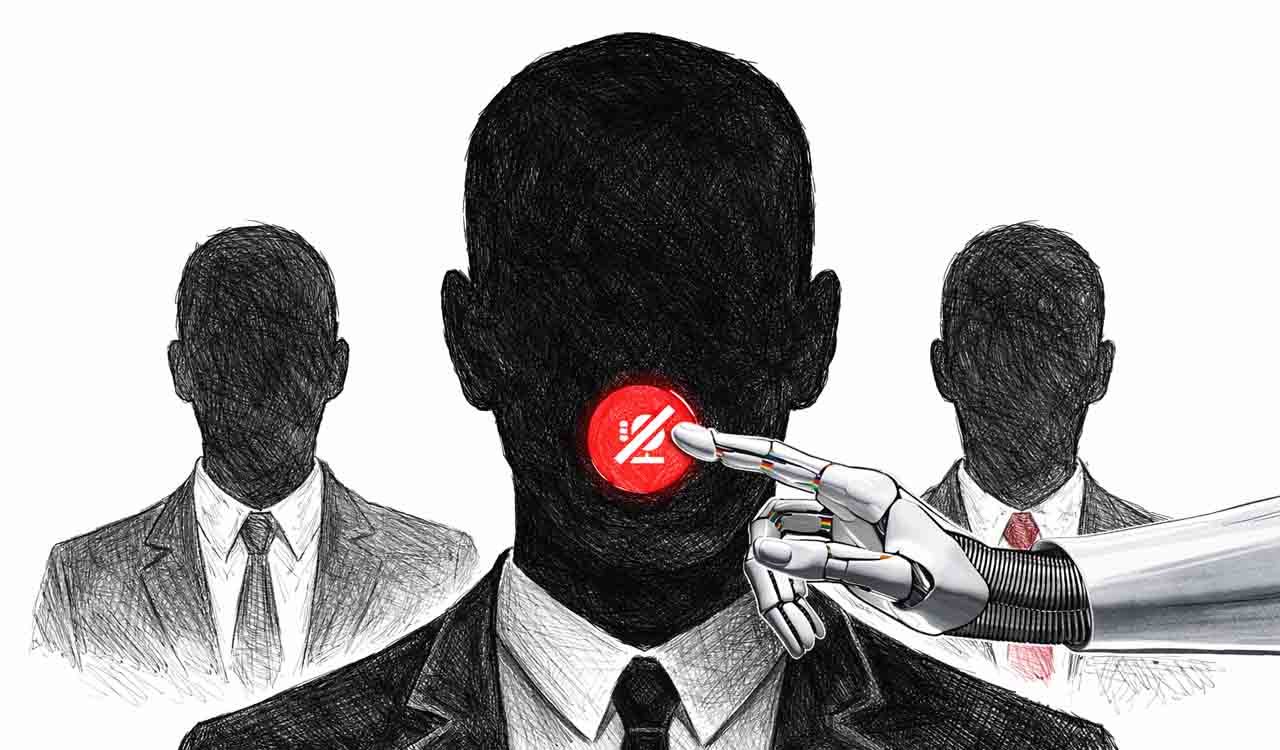
If AI replaces human capacities, society may become ultramodern but fragile, digitally connected yet physically fragmented, and notionally present yet socially estranged
Published Date – 9 February 2026, 11:23 PM
By B Maria Kumar
The recently concluded World Economic Forum (WEF) 2026 meeting in Davos, though usually dominated by political, economic, and business interests, seems this time to have taken a sharp turn towards a new existential path — at least as far as artificial intelligence (AI) is concerned. There were both utopian and dystopian perspectives, ranging from expectations of infrastructure booms, job creation, and improved economic outcomes to growing public anxieties surrounding AI and robotics.
Until now, the existential threats, routinely debated in relation to the unbridled proliferation of AI systems, have included dangers such as the accidental launch of autonomous weapons — conventional or nuclear, abrupt financial system breakdowns, or large-scale climate disruptions with irreversible effects on human survival. There are also AI-driven risks involving synthetic pandemics, biochemical warfare, and unforeseen modifications in genetic engineering, all of which challenge our ability to oversee what we bring into existence.
Dangerous Friend
Beyond all this, what emerged from one of the panel discussions in Davos was something that made the world aware of a fundamentally new threat in the making. Yuval Noah Harari, a historian and philosopher, while discussing humanity and AI with Max Tegmark, co-founder of the Future of Life Institute, and Bloomberg’s Francine Lacqua on the sidelines of the WEF, expressed his concern about the gradual dwindling of face-to-face interactions among people. He elaborated on how AI is not only a weapon or an industrial tool, but is also increasingly becoming a companion, sometimes even a “friend.”
Not just adults, but even children now talk to AI intimately, confide in it, seek reassurance from it, and experience a sense of being heard without judgment. This, in itself, is not inherently harmful. The danger lies not in friendship with AI, but in the replacement of moral effort. Human relationships are demanding. They require patience, tolerance, negotiation, forgiveness, and vulnerability. They involve friction, misunderstanding, and emotional risk. AI interactions, by contrast, are comfortable. They adapt to people’s preferences, do not contradict harshly, and do not demand reciprocity. When humans begin to choose comfort over moral work, the social consequences are subtle but serious.
About a decade ago, Time magazine’s mobility poll showed that as many as 32% of youth aged 16–24 preferred to communicate by text rather than through other means. Today, however, in the midst of an expanding AI jungle, the growing exclusivity of tech-savvy youth from their peers within social circles has become alarming. Is the modern generation in the process of transforming itself from Generation Cute to Generation Mute?
World of Strangers
When individuals increasingly enclose themselves within personalised digital worlds shaped by algorithms, screens, and conversational AI, the need for in-person interaction diminishes. Talks with neighbours, colleagues, and even family members become fewer. Disagreement feels exhausting. Difference feels threatening. Slowly, almost imperceptibly, people begin to feel like strangers to one another, even while living in close physical proximity. This condition can be described as a shift from coexistence to mere co-presence.
When people no longer regularly see, meet, or interact with those who are different, the unknown begins to feel threatening
Co-presence means sharing space without sharing life. People stand next to one another, travel together, and scroll together, yet do not actually encounter one another. Coexistence, by contrast, is an ethical achievement. It requires living with difference, enduring discomfort, and continuously negotiating purpose and meaning with others. It is not automatic; it must be practised.
As this practice weakens, an old instinct resurfaces with new force, which is fear of the stranger. Xenophobia, in its most basic sense, is not always hatred of a fellow human being. Often, it is fear born of unfamiliarity. When people no longer regularly see, meet, or interact with those who are different — physically, psychologically, culturally, ideologically, or socially — the unknown begins to feel threatening. Over-engagement with AI and digital involvement can unintentionally intensify this fear by reducing exposure to real, complex human presence and shared conscience.
What makes the current situation particularly delicate is that the erosion of fraternal bonds is happening slowly. There is no sudden collapse. Instead, there is a gradual withdrawal into comfort zones, growing impatience with disagreement, and increasing reliance on systems to mediate decisions, relationships, and even emotions. Over time, humans risk outsourcing not only labour and cognition, but also the moral responsibilities they owe one another.
Reclaiming Co-existence
This is why reclaiming human coexistence is not optional but essential. Human survival has never depended solely on intelligence or efficiency; it has relied on the ability to live together despite differences and uncertainties. In this sense, coexistence precedes existence. Before individuals can flourish, societies must sustain the moral fabric that enables people to trust, tolerate, and care for one another.
AI does not negate this truth; it sharpens it. The more powerful the technological tools become, the more deliberately humans must practise fraternity, judicious conscience, tolerance, restraint, and empathy. If AI is allowed to replace these human capacities, society may become ultramodern but fragile, digitally connected yet physically fragmented, and notionally present yet socially estranged.
The challenge before us, then, is not to reject AI, nor to romanticise a pre-digital past. It is to insist that technology remain an extension of human responsibility, not a substitute for it. Only by doing so can we ensure that the future is not one of intelligent systems and isolated individuals, but of humans who continue to coexist — imperfectly, conscientiously, harmoniously, and truly together.

(The author, a recipient of National Rajbhasha Gaurav and De Nobili awards, is a former DGP in Madhya Pradesh)